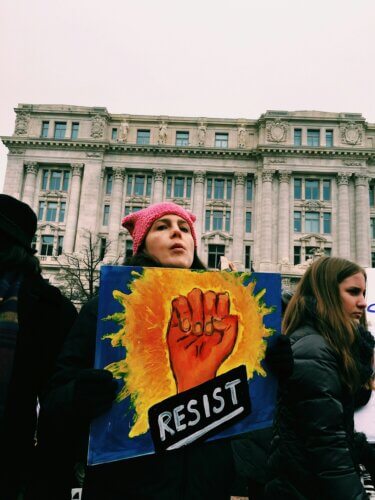
As the United States prepares for another No Kings Rally on March 28, emotions online are running high as seasoned organizers—many of them Black and Brown folks—express hesitation that another national rally will do much to move the needle on our current conditions in the United States. In turn, many white-bodied people are feeling prickly as BIPOC folks online express their irritation at the enthusiasm that some many white people are showing for No Kings.
As the executive director of Community Change Inc.—a racial justice organization founded in 1968 with the explicit mission of working with white people to dismantle white supremacy (as carried out via structural and institutional racism) through education, awareness, and mobilization—I have a lot of feelings. Some of which I recently shared over on Threads. My primary concern being that too many white people are treating their activism (and in some cases, very newfound activism) as something they can just fit into their lives as time allows. But let me be frank: Time is really ticking here.
In fact, some might say that for many things like the arrival of fascism and authoritarianism, the clock has already ticked down and now we’re in the damage control and extraction phase, not prevention anymore.
While millions have been newly activating over the past year and are building community and getting involved locally—and good work is being done often at the local levels—I fear that these efforts may not be anywhere near enough. To be completely honest, as long as our actions and events involve little in the way of personal risk and/or true disruption to the current systems, there is little chance of changing the course that the regime has set us upon.
We need to be clear on what we are doing. What is the goal and what is the ask? (and what are we willing to do to get there and get what we demand?)
In my work, I see many flocking to provide community care and mutual aid. I am not against this; in fact, I have often encouraged it. As we look at the potential collapse of our economic systems, care and aid will be vital. But it does beg the question lately: Are we just going to try to survive authoritarian rule and accept that it is our new reality or are we going to really and truly push back?
Cities that have been impacted by enhanced ICE activity, including in my own state of Maine, have seen local activists and organizers come together to protect people and keep people safe, but that work still requires more of us. More people, more resources.
I also see in my work how cultural whiteness and lack of self-awareness are proving to be barriers to multiracial organizing and building. Right now, we need the expertise and skill of Black, Brown and marginalized organizers who organized during the Occupy Wall Street and Black Lives Matter years—and really in the last 20 years in general. While we can look at the organizing of the Civil Rights era and the women’s rights and LGBTQ+ rights movements as a draft blueprint, we also need to build out for what we are facing in today’s world. That doesn’t just mean adapting things to different technological and societal factors. It also means a racial and class analysis is fundamental to success. Too many white people are asking “Where are the BIPOC people at these events?” Or they ask, “Why are they being mean to me about my protesting style?” But they don’t consider how much their own actions and attitudes are the cause of this.
Too many white people who are taking the streets have not shown themselves to be safe allies, much less accomplices to BIPOC people, and they simply don’t understand that trust is necessary to success. What is also critical is an awareness of how we got here to begin with. As a Black woman, I often hear from other Black people that they have a real reluctance to ever organize with white people. Why? Because those white people treat their current activism as “just another thing to do” instead of treating it like a life or death thing.
Which is why watching white people get defensive over their attendance at past No Kings or their plans to attend this next one caught my attention.
As long as the critical mass of white people who are attending rallies and protesting believe that our issues are just Trump and his cabal, we are not on the same page. Trump is the pus-filled symptom of the larger issues in this country. A single unhinged human couldn’t do what he has done in just over a year if the system wasn’t working exactly as it was designed to do. Which is why the resistance efforts of the moment aren’t enough.
That is an uncomfortable truth, but more people need to face it head on and deal with it.
Just as this administration is disrupting the world, eventually a large mass of Americans will need to become daily disruptors of the administration and its works—as well as the works of its enablers and supporters. We can’t just go to work, take the kids to soccer and then fit in our activism as time allows and then somehow expect a change.
The success of the Civil Rights Era largely stemmed from sustained disruption to systems. People were willing to inconvenience themselves for a greater cause. It was hella inconvenient for people to not take buses in order to force change. It was “inconvenient” to say the least to sit at whites-only lunch counters knowing you were going to either get your head knocked in or get arrested.
Since making some of my thoughts known on social media, I have had white people in my comments, especially on Threads, explaining to me that they are building connections and community and increasing awareness through visibility.
These are all absolutely valid things that are important.
But if we are going to shake up the systems and possibly remove or otherwise disempower the current people who are crashing the world, the only thing that is going to do that is disruption. We already know, especially here in Maine, the limitations of emailing and calling our Congressional delegations. Susan Collins gives not a single fuck when we email or call her about anything not on her GOP-decreed agenda, and she is far from alone among people in power in having that feeling.
Listen, if this is your first No Kings protest, welcome to the resistance. But if you were at last year’s protests and you haven’t done anything more than show up to hold signs since then, it’s time to be thinking about what else you can do. What is your position in life and can you afford a higher level of risk?
During the era of Black Lives Matter, I had colleagues who shut down highways at rush hour, others who were willing to be on the ground on the front lines facing off with the police, and still others raising money for bail funds and mutual aid and assisting with training such as marshalling and de-escalation tactics. In the aftermath of George Floyd’s murder, it was the first time that a critical mass of white Americans really paid attention to the state of race in the country. The thing is, the protests that you saw in 2020 and maybe even participated were a continuation of the work that started in the early 2010s back in places like Ferguson, Missouri, when Mike Brown was killed.
But the attention of those people faded and wavered instead of persisting and growing, and here we are now with full-blown authoritarianism and new evils unveiled every day because when things got a little better people decided to go back to “life as usual.” Well, the folks running this regime now didn’t stop their work or cease their energy back then. They pushed harder and kept pushing.
Let me be clear: In every community in this country there is localized work that needs to be done, from getting involved in activism to making change in municipal and state government, including running for local office. I did it myself in 2021; I served a year in local government, so I am not just talking out of the side of my neck. My year in local office in Portland, Maine, as the vice chair of our city’s Charter Commission had a profound effect on my work and how I see change as possible. We know that a big part of why the right wingers have been so successful in pushing their agenda is because they got folks aligned with their ideology in positions all across the country, at all levels.
The right also funds their beliefs, and I say that as the director of a grassroots organization that has been around since the Civil Rights movement that has been constantly underfunded and is currently struggling to stay alive. In 2018, two years after Trump was in office the first time, we piloted a program to train white folks in Massachusetts suburbs to organize at the community level and to create connection to statewide BIPOC initiatives and efforts. The early pilot was successful enough that we were working to bring the program to Maine and other parts of New England, but then COVID happened, Biden won, and a year after the “great racial awakening” of 2020, interest shifted and white people stopped caring as much.
Every day since Trump has gotten back into office, I wonder what it would have looked like if we could have grown that program the way that we envisioned it to be—if people hadn’t just gone back to “normal life.”
Even with their media, the right invests in it. Here in Maine, we have a right-wing media outlet, Maine Wire. It is a well-funded operation that is well-read, even by people who may not see themselves as right-leaning because they are resourced enough that they are literally everywhere, including hounding elected officials of color and yelling fraud allegations left and right without any basis. Meanwhile, localized more moderate or left-leaning media struggles to stay afloat. I have been asked by several campaigns for candidates running for U.S. Senate in Maine (who aren’t Graham Platner or Janet Mills) and for governor if I might be interested in meeting with them to possibly write about them. While I would love to use the BGIM Media platform to give coverage to more of the people who aren’t getting coverage, I don’t have the time nor do I have the ability to pay the multiple skilled writers and editors I would need to hire. Just like my day job isn’t well-funded right now, neither are my online platforms. I’m one person with extremely limited support.
This isn’t an attempt to make anyone feel bad for reading my work and not being a paid subscriber on Substack or a patron on Patreon. My point is that the causes we care about—even down to the media coverage—probably could use support. Fundraising and willingness to give funds to progressive causes too often focuses only on the most well-known causes, but the support is needed everywhere because smaller, more niche, and more localized causes fill needs more well-known ones overlook or can’t handle.
Lastly, if you are a white person who is engaging locally and attending No Kings and you feel defensive when a person of color criticizes you, how about not getting defensive? How about instead seriously asking yourself why they are criticizing and do some self-examination?
Criticism and critique are opportunities to grow, especially if this is your first rodeo or if it has been decades since you last did activism. Some of us have never had the opportunity or privilege to be able to ignore the external world happenings, because we’ve been suffering the effects of them—and sometimes being openly oppressed by them—our entire lives.
So, when we offer critique and ask you to do more or go deeper, it isn’t always a dig at you. For me, I want liberation for all of us. I want more than to see the Orange Menace gone; I want us to work to dismantle the structures that made men like him possible. I am playing a long game here. Hopefully you are too.
If this piece resonated with you, I would love it if you would consider buying me a coffee. If you want to access all of my work, as soon as it is released consider becoming a monthly patron, if you aren’t already. I offer my work freely, to ensure that it is accessible to all but if you have the means to support it, please do so. Remember, I do work with groups and organizations, if you want to work with me, please reach out for details.
