For a year-and-a-half, we have watched ICE come into communities to terrorize and kill people in upholding what increasingly feels less like immigration policy and more like ethnic cleansing. All to satisfy Stephen Miller’s twisted blueprint for a white nation. Each time they come into a community and take a life, our feeds are filled with coverage—we then rally, we let our voices be heard, and eventually the national media moves on to the next story.
Meanwhile, while everyone else moves on, the local communities are left to grapple with the impact of this reign of terror that has been forced upon them.
Monday, that reign of terror struck close to home for me in Biddeford, Maine. Biddeford—or Biddo as some locals refer to it—isn’t just some random place 16 miles away from me on the mainland. It is part of the community I lived in for my first 13 years in Maine. A place that is still home to me.
Biddeford is right across the river from Saco joined by a couple of bridges. Sister communities, you’ll often hear Mainers just say Biddeford-Saco when they refer to the area. My second husband and I purchased a home in Saco in 2004, placing us less than 10 minutes away from Biddeford by foot. My son spent half of his childhood in the community. My water broke with my now almost 21-year-old daughter at the local Indian restaurant in Biddeford. I spent five years as the executive director of a now-defunct nonprofit in Biddeford, Joyful Harvest Neighborhood Center, that for the better part of two decades was a safe refuge for low-income youth seeking no-cost summer and after-school programs, including meals. Post-divorce, the house is occupied by my ex-husband and he, I, and our kids refer to it as “the family compound.” Saco and Biddeford are still a homebase for me.
When I worked in Biddeford, it was still pretty homogeneous but in the 12 years since I left that position, new arrivals have come to seek a better life. They continue the long history of immigrants settling in Biddeford. Biddeford was historically a mill town settled by French-Canadian (Franco) immigrants who, when they arrived decades ago, had to deal with anti-immigrant and anti-Catholic sentiment. So much so that the KKK marched the area in the early 1900s to harass and try to scare them away. But over the years, the hateful rhetoric settled down and Franco’s became a part of the community, claiming Biddeford as their true home.
Now in the 2020s, we see Black and Brown immigrants setting into Biddeford, building businesses, becoming a part of the community, and adding to the town motto of “A proud city rising where the water falls.” Just weeks ago, I was honored at Biddeford’s fourth annual Juneteenth celebration, receiving the Voices of Change Award on behalf of the City of Biddeford’s Diversity, Equity and Inclusion Committee, the Maine Black Chamber of Commerce and the Heart of Biddeford.
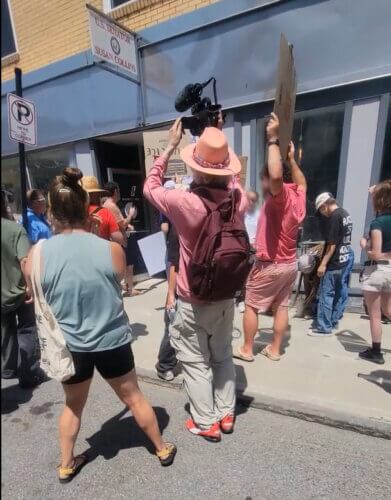
Suffice to say that the horror of this latest ICE killing hurts deeply. They all hurt and they are all horrific, but when it happens in your community, it adds a particularly macabre feeling. When I heard the news and saw that community members were planning a rapid response for noon, I reached out to local community organizers. It turns out that a number of the local organizers I know both from my current day job and from the years I spent working in Biddeford were the ones organizing. I shifted my plans for the day and decided to show up in solidarity and to hold space for a life that was snuffed out by the regime.
I walked with the group, eventually speaking since the organizers asked if I would add my voice to the handful of speakers there. By the time I spoke in the afternoon, we had learned the deceased was a 26-year-old man who left behind a wife and a three-year-old child. As a mother of two adult children and grandmother to a two-year-old, a pair of three-year-old “Irish twins” and a nine-year-old. my heart dropped even deeper. Later it would be revealed that the child was present during the state-sanctioned murder.
At this moment, there are no words other than we have to realize that no community is immune from the state-sanctioned violence that ICE is inflicting upon the people of this country.
Maine is literally the whitest state in the United States. The entirety of the BIPOC population here is 8% of the total population, which to begin with is only 1.5 million people in total. And yet in the last seven months, Maine has seen enhanced ICE activity, with a surge in January that led to about 200 people being arrested. We have been seeing a marked increase in ICE activity in recent days and weeks again after the initial surge “ceased,” and this latest escalation of course led directly to this senseless tragedy.
It is a tragedy made even more horrific as it seems that the victim, Joan Sebastian Guerrero, was not the target of the warrant that ICE was trying to execute. Instead, he was a father and husband in the car with his little girl who was wearing Bluey pajamas. A little girl whose father’s body was left handcuffed and laying on the ground for five hours after they took his life. It brought back memories for me of Mike Brown in Ferguson and so many other state-sanctioned murders. According to reporting by the Portland Press Herald, the agents weren’t wearing body cameras. Oh, and for the folks who want to paint Guerrero as deserving of ICE attention anyway because of his name and skin color, well, he was legally authorized to work in the country.
A man lost his life, a wife lost her husband and a child lost her father because we have racist, xenophobic people in charge and at some point as a country we need to decide if we are resigned to accepting that every week or so, these people will just be tearing up a different community in the country as we hope and pray it doesn’t come to our communities and as we pray they don’t murder yet another innocent.
The mood on the ground in Biddeford was mostly somber and angry, though that anger got more animated (peaceful, but more energized) at times, especially when the crowd gathered outside a local office of U.S. Sen. Susan Collins, whose hands directly bear blood for supporting the president’s anti-immigration efforts and pretty much almost everything he does (even though she pretends to be a moderate). A number of Senate candidates looking to unseat Collins were on the ground, as were local organizers and Mainers from other parts of the state showing up in solidarity. I met a woman who traveled two hours to hold space—a woman whose husband is battling cancer and clearly has a lot on her heart already. I held a young Black Muslim leader who wept in my arms. Afterwards, I sat as a state senator and others wept openly.
At this moment, as an elder in Maine’s BIPOC community—despite being a writer—this isn’t just another story for me. I have worked with white people in this state and region to develop an anti-racist framework and while I was heartened to see so many whom I have worked with over the years show up and organize at this moment, it isn’t enough.
It’s not enough to scream, “Get out ICE!” We need to mobilize as if our lives depend on it. We need to keep each other safe and we need to stay at it. We can’t come out for a few days or weeks and return to our lives, because the painful truth is things aren’t getting better. In Maine, we have seen the ICE activity increase for weeks and commenting on it within organizing and resistance circles, and yet it was only days ago that it was reported in the media that they had picked up their pace again. Just a few weeks ago, one of the stylists at the salon I go to was detained by ICE. People have messaged me and reached out to tell me of people being detained and yet, outside of activist spaces, people had no idea.
Markwayne Mullin, who replaced Kristi Noem as head of the Department of Homeland Security, is actually worse than she was. While he lacks the attention-seeking ways of the two previous ghouls (Noem and Border Patrol’s Greg Bovino) who were responsible for the initial reign of terror we saw with immigration enforcement, it turns out that Mullins and marble-mouthed Tom Homan are far more effective at the job. By not seeking the spotlight like Noem and Bovino and by not being splashy, they have created the false illusion that ICE has slowed down when actually nothing could be further from the truth.
Maine is a small, primarily rural state and in recent months, we have weathered a lot of unwanted attention. This recent tragedy only adds to that attention and stresses with it, but Mainers are a hardy lot that believe in the power of community. We will weather this horrific tragedy.
But it is a reminder that no one is safe in this new iteration of America and until we decide to take sustained collective action nothing will change in that regard—in fact, it will get worse and the dead bodies will stack up faster.PS: As an independent writer, as much as l love your comments and sharing, your financial support is what keeps my writing viable. Become a Substack subscriber today, or if you are interested in my more deeper and personal writing with an anti racism lens, become a Patreon patron. Or if you just want to show your gratitude for this piece, consider Buying Me a Coffee.