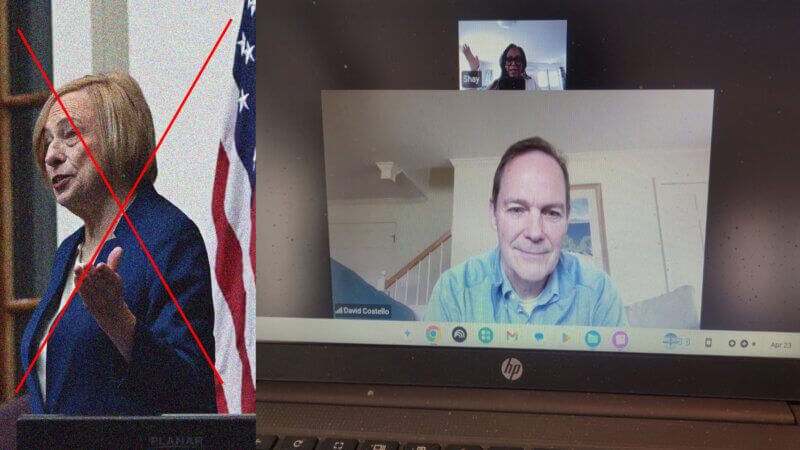
It’s a gray, rainy day here in Maine as I write this but the energy is crackling all the same as the state and political circles grapple with the aftermath of U.S. Senate candidate (and current Maine governor) Janet Mills’s announcement less than six weeks before the primary that she is suspending her campaign for the U.S. Senate race. Left standing in the race for the Democratic nomination are Graham Platner, David Costello, and write-in candidate Andrea LaFlame. As a Maine voter and a writer who touches a lot of politics lately, I have been following this race intensely (especially after I decided to meet with the three political newcomers), and while many are in shock and stunned, I can’t say that I am entirely surprised.
Right after I met with write-in candidate Andrea LaFlamme a few weeks ago, I received a message from someone who knows Mills who asked if I would consider meeting with the governor and doing a write-up on her as I had done (or planned to do) with the other three candidates. I looked up the person, asked a few of my sources if they were familiar with this person (and they were), and it seemed to be a legitimate offer to meet with Mills. To be honest, though, I wasn’t interested in talking to Mills, as my focus was really only on the political newcomers. Also, I doubted my ability to be objective in meeting with her due to my own feelings around Mills based on her policies and a few brief encounters over the years—I will just say that I found her to be performative in a way that, combined with her spotty track record when it comes to BIPOC and marginalized people, left a bad taste in my mouth.
The offer though struck me as strange, though. Mills is the current sitting two-term governor. Unlike the other candidates, she has no real impediments to getting public attention. Why would my thoughts on her be needed? After all, she is not only the current governor but also former attorney general of Maine. She also was heavily backed by the establishment Democrats at the national level. People know who she is and where she stands on the issues; there are no unknowns to speak of.
Of course, if the campaign was floundering and slipping in its ability to gain the traction and raise the financial support it needed (particularly with polls recently favoring Platner over her in the primary), meeting with a long-time, established Maine blogger could be useful. Or not. It raised my suspicions at the time, so when the announcement was made that she was dropping out, I wasn’t exactly surprised, especially as she stated her reason for suspending her campaign came down to cold hard cash.
Recently, a personal friend who spent time in the Maine legislature and who has worked in political spaces both at the statewide and national level told me that a U.S. Senate run can cost upwards of roughly $20 million, if not more. At least two million for the primary and upwards of twenty in the general election.
That’s a lot of money and, as wild as that price tag sounds, it also makes sense when I think back to how in 2021 I spent $7,000 to win a local seat for a completely unpaid position.
That means that for the remaining candidates vying for the attention largely dominated by Mills and Platner thus far—Andrea LaFlamme and David Costello—they have their work cut out for them. Neither one of them is suspending their campaigns thus far, with Costello issuing a statement on Bluesky and LaFlamme on Threads reminding folks about them and their run and their need for support.
Regardless, though, it looks like Graham Platner has gone from being the frontrunner in the primary race to being the presumptive nominee, with the national Democratic Party Party putting up a post on Instagram saying, “Maine, let’s send an oyster farmer to the US Senate.” Here in Maine, several Democratic gubernatorial candidates—Shenna Bellows, Troy Jackson and Dr. Nirav Shah, all three top contenders in the governor’s race—put up posts endorsing Platner and saying we need to work to send Platner to the U.S. Senate.
While the majority of Maine voters and outsiders may feel the race is a done deal, whether they like the presumptive nominee or not, Maine isn’t like most states. We have ranked choice voting (RCV) here. Per the state of Maine website, RCV allows voters to choose their candidates in order of preference, by marking candidates as their first, second, third, and subsequent choices. The votes are tabulated in rounds, with the lowest-ranked candidates eliminated in each round until there are only two candidates left. The one who is determined to have received the majority of the votes (more than 50%) in the final round is declared the winner. It is different from our previous method of voting, in which voters choose only one candidate for each office and the winner is determined by plurality (whoever gets the most votes).
RCV means Maine voters have the opportunity to vote for their preferred candidate without also throwing away their vote for someone who may be more likely to win and still be a viable choice for them. One of the problems when you don’t have RCV and you can only make one choice is that if you choose your favored candidate and they are a longshot, you might open the door for someone you don’t like to end up winning over someone you would have preferred. Or, as we’ve seen before, an independent and a Democratic candidate can split the vote, allowing a destructive right-wing Republican to win who otherwise would have lost (especially if RCV were in place, since the majority didn’t want the right-wing asshole).
So, despite today’s announcement and the turn of events that certainly favor Platner, I decided to still share a few thoughts on U.S. Senate candidate David Costello because people still do have the ability to truly vote with their hearts and values and still be strategic thanks to RCV. Costello and I met briefly last week and to be honest I was actually preparing to write about that meeting today when the announcement was made that Mills is suspending her campaign.
So, here we are. Time for David to get his turn.
David Costello is an interesting candidate. My initial thought from our meeting was that, in many ways in the world of yesterday’s politics, he might have been a frontrunner in the race. But in today’s world, most Maine voters don’t know who he is and that goes double for folks outside of Maine.
A son of Maine, born in Bangor and raised in Old Town by his mother and his mill worker grandparents, David describes himself as having grown up working class. His father was a military veteran and labor organizer who died early. Despite such humble origins, Costello is a graduate of the University of Maine, George Washington University, and the London School of Economics.
He spent over 30years in senior-level government and non-government positions both abroad and in the States. Notably, he was both a program manager and team leader with USAID, the same USAID that was dismantled by Elon Musk and DOGE in 2025.
When I asked Costello why he aimed for the U.S. Senate instead of the Maine state legislature, he said he felt that his decades of experience in the government and NGO sectors gave him a perspective that would allow him to hit the ground running in Congress, where he felt that he could have a greater impact in creating the structural change that our country deserves.
He is passionate in his feeling that his ideas could strengthen our democracy and help restore a sense of order to our nation. He also doesn’t feel the current Senate is democratic. His view is that we need more proportional democracy and strongly supports the idea of reforms that would alter the Constitution’s amendment process.
Costello was very honest and realistic in our meeting; he openly acknowledged that he is an extreme longshot candidate owing to the fact that relatively few know who he is.
However, this also isn’t Costello’s first rodeo when it comes to running for the U.S. Senate—he ran against current Sen. Angus King in 2024 and he earned nearly 90,000 votes despite having spent only $30,000 in that race. When asked why he didn’t gain much traction in 2024, much like his current run, he said he felt that the media iced him out despite being the Democratic nominee. That reporters didn’t bother to talk to him and the folks who did vote for him went with him because he is a Democrat. Note: Angus King is an Independent (and former Maine governor) who often caucuses with the Democrats.
Yet, despite his loss in 2024 and knowing that he is a very longshot candidate, he believes people want alternatives and he feels that of all the candidates, he has the broadest governing experience due to his career. He also thinks the country needs structural change and that our democracy needs strengthening. I asked him to elaborate on what strengthening democracy would look like for him as a freshman senator.
Banning gerrymandering and the filibuster and instituting campaign finance reform are some of his top thoughts around how he would work to strengthen our democracy, as well as reinforcing the Civil Rights Act. Additionally, he thinks we need term limits for the courts as well as for legislators.
In our conversation, I was struck by the fact that he was fully prepared to go deep in the weeds on political thoughts. His website is loaded to the gills with information on his positions, and a recent candidate profile on Maine Public Radio fills in the gaps. He does have a breadth and depth of experience that makes his candidacy worth learning more about and I hope people choose to do that.
In meeting with all three political newcomers, they all touched upon the reality that money does play a role in campaigning—justly or not. Money creates visibility, especially for newcomers. Both David Costello and Andrea LaFlamme pointed out that the lack of visibility of their campaigns is directly tied to a lack of funds. As a media-adjacent person, I know that the media has shifted and, in today’s world, attention is often tied to money.
Our political world has changed and in many ways it asks more of us than offering hot takes online and just showing up to vote. It requires our participation and not our assumptions. If there is any takeaway from the political shifts in Maine and by extension national politics, it is seeing a candidate such as Mills step down—a candidate who by all accounts should have been raising enough money to get through the primary.
At this time, I won’t be offering my input on how to rank the remaining candidates, but I will say this: Your candidates need your real-time support. Knock on doors for them, attend their events, raise funds for them.
We aren’t just fighting against Susan Collins or Trump. We are fighting against authoritarianism. We are fighting against systems that seek our dehumanization. We need to remember that and act accordingly.
Just yesterday, the Supreme Court essentially gutted the Voting Rights Act. The Trump administration is rolling us backwards as a nation and, in the end, voting is only one part of how we get out of our current predicament.
No single candidate is going to save us; our collective survival is a group project.
If this piece resonated with you, I would love it if you would consider buying me a coffee. If you want to access all of my work, as soon as it is released consider becoming a monthly patron, if you aren’t already. I offer my work freely, to ensure that it is accessible to all but if you have the means to support it, please do so. Remember, I do work with groups and organizations, if you want to work with me, please reach out for details.