NOTE: Almost certainly this piece will travel beyond my usual readership, so I thought it wise to add a quick preface. I am not a journalist by trade or training. I am a writer who traditionally has written long-form pieces commenting on or analyzing social issues like race and racism, and I have added writing of shorter pieces on political issues and current events in more recent years. I have been writing and blogging since the early 2000s, but my day job is serving as executive director of one of the oldest anti-racism organizations in the United States. Lastly, if you are interested in reading my first piece on Graham Platner, based on our initial meeting in fall 2025, you can find it here. (or, copy-paste https://blackgirlinmaine.com/current-events/musings-on-the-political-and-graham-platner-reflections-on-a-conversation-part-1/ if this appears somewhere where the hyperlink for “here” isn’t present or visible)
OK, the wait is over. I’m ready to wrap up talking about Graham Platner until at least after the primary elections are done with.
For months, I have been bombarded by readers and others asking when I was going to write my follow-up on my meetings with U.S. Senate candidate Graham Platner of Maine. The truth is that I really struggled with whether or not I wanted to do a follow-up at all. After publishing my first piece on him in December 2025, and finding myself being called—among other things—a Nazi sympathizer and a star-struck gullible tool, I decided as a Black woman who deals with enough macro- and micro-aggressions daily already that I needed to protect my mental health. As someone who has made a side career of writing online, the current-day state of social media isn’t for the faint of heart—nor even for seasoned folks like me who’ve built up some callouses. It has become a polarizing place where nuance is lost and people are increasingly more interested in supporting and upholding their view even in the face of proof that their beliefs are inaccurate or misguided.
However, a few mornings ago, I awoke to a message from a fellow writer friend about a conversation happening on Threads. A Black woman who doesn’t reside in Maine, she had received a fundraising request on behalf of the Platner campaign and she wrote back that despite reading Platner’s recent interview with The New York Times and other pieces, she was still concerned about his previous comments on Black people and was concerned about his overall lack of outreach to Black voters. She suggested that he do an interview with a largely Black audience so that he could make a clear, full-throated statement in support of BIPOC people and other marginalized groups.
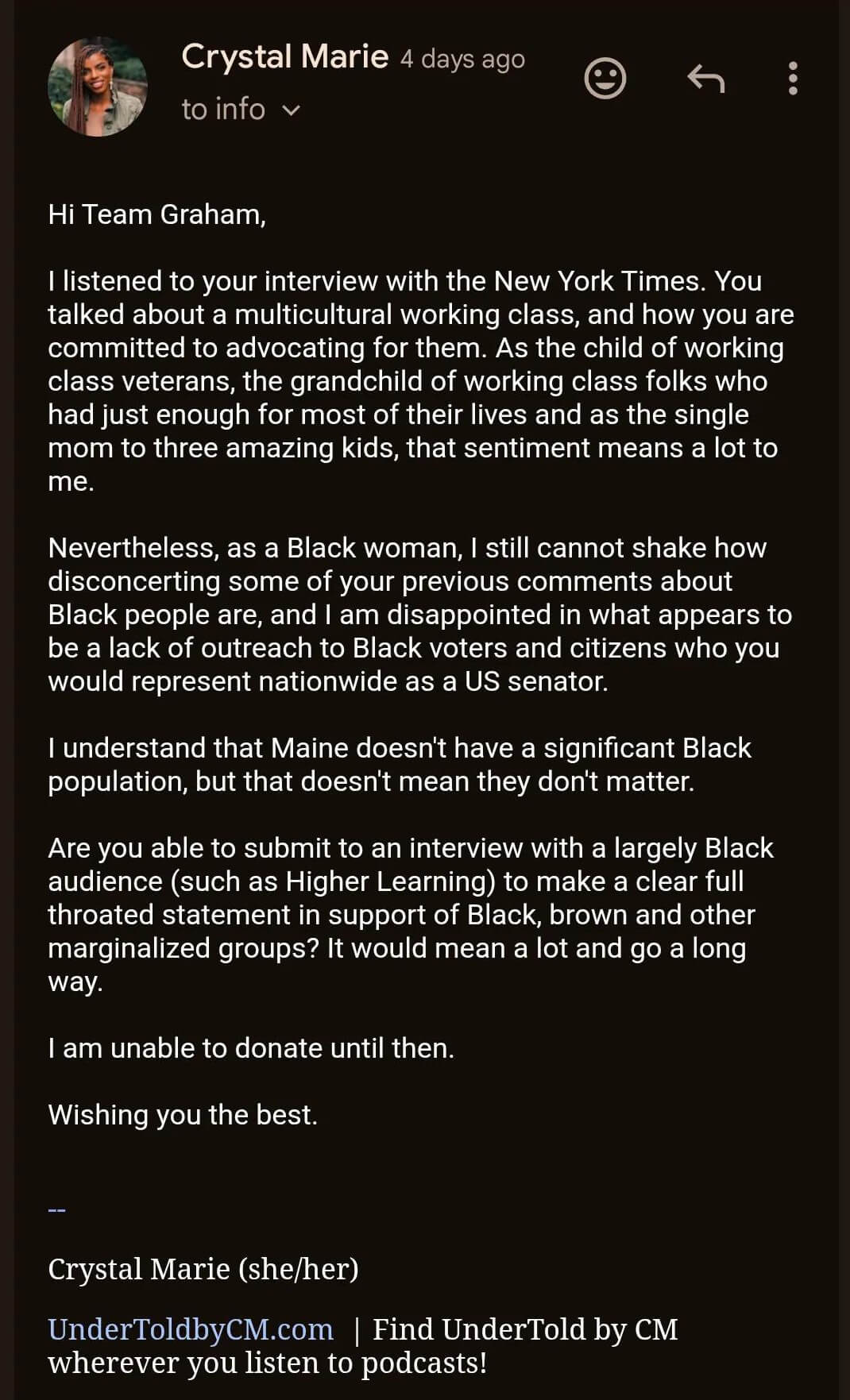
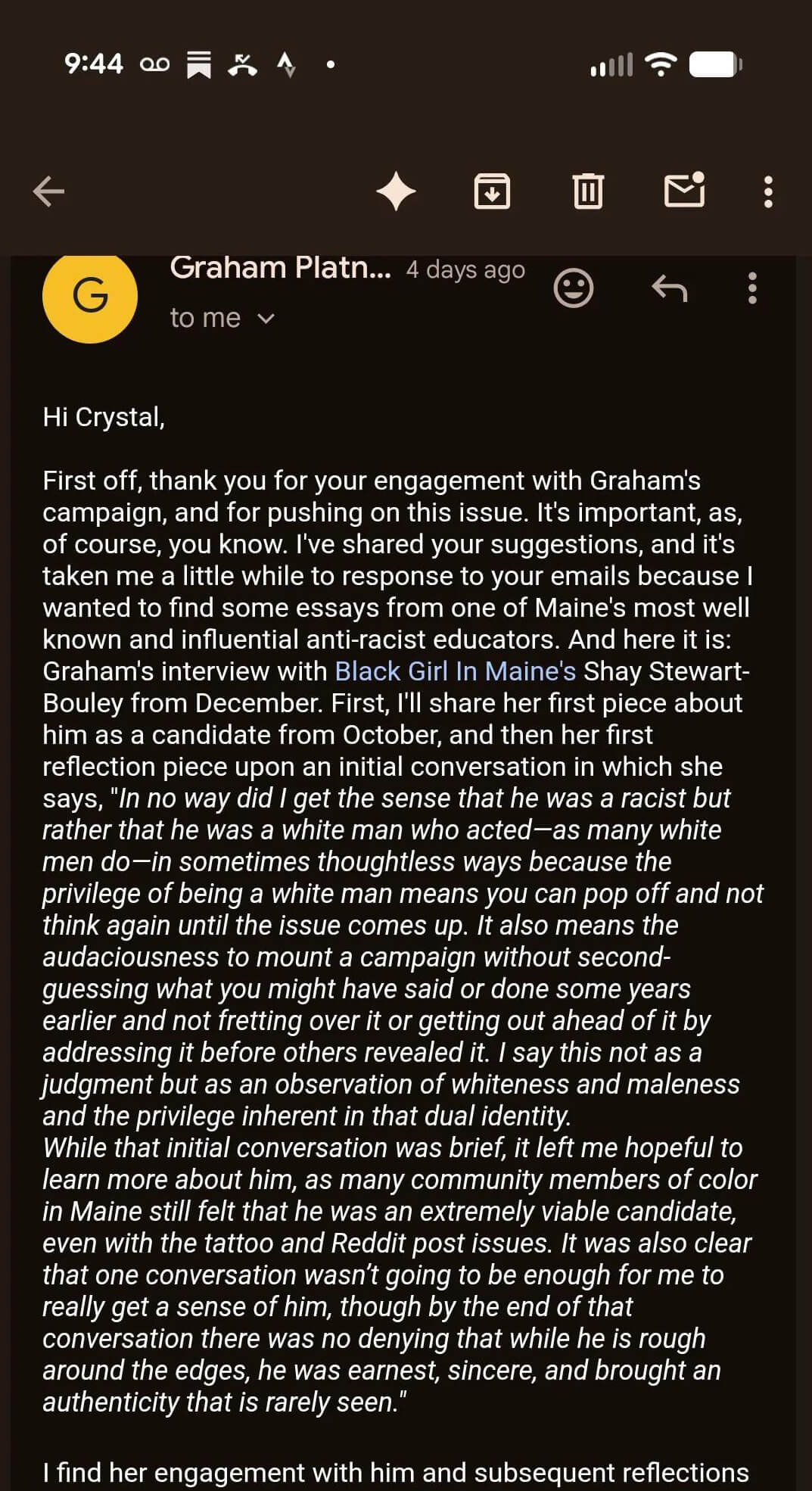
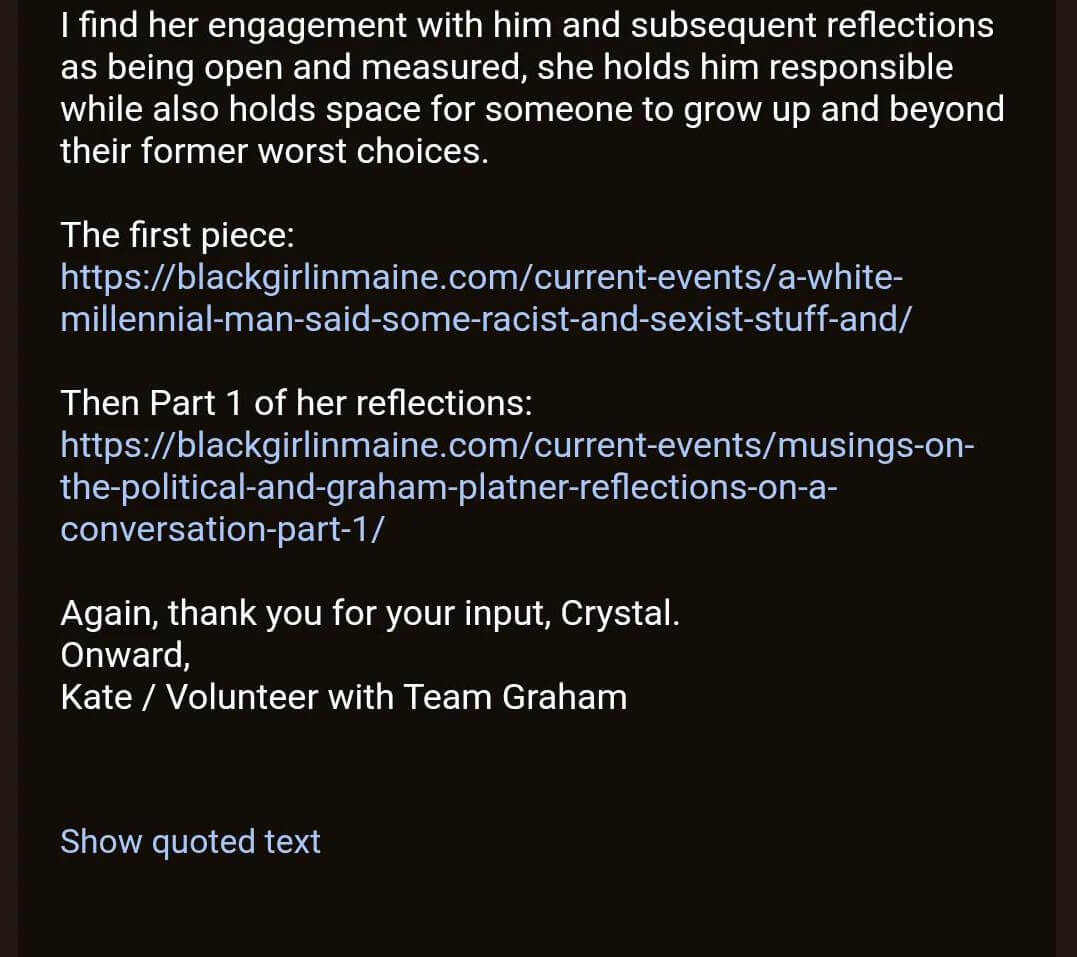
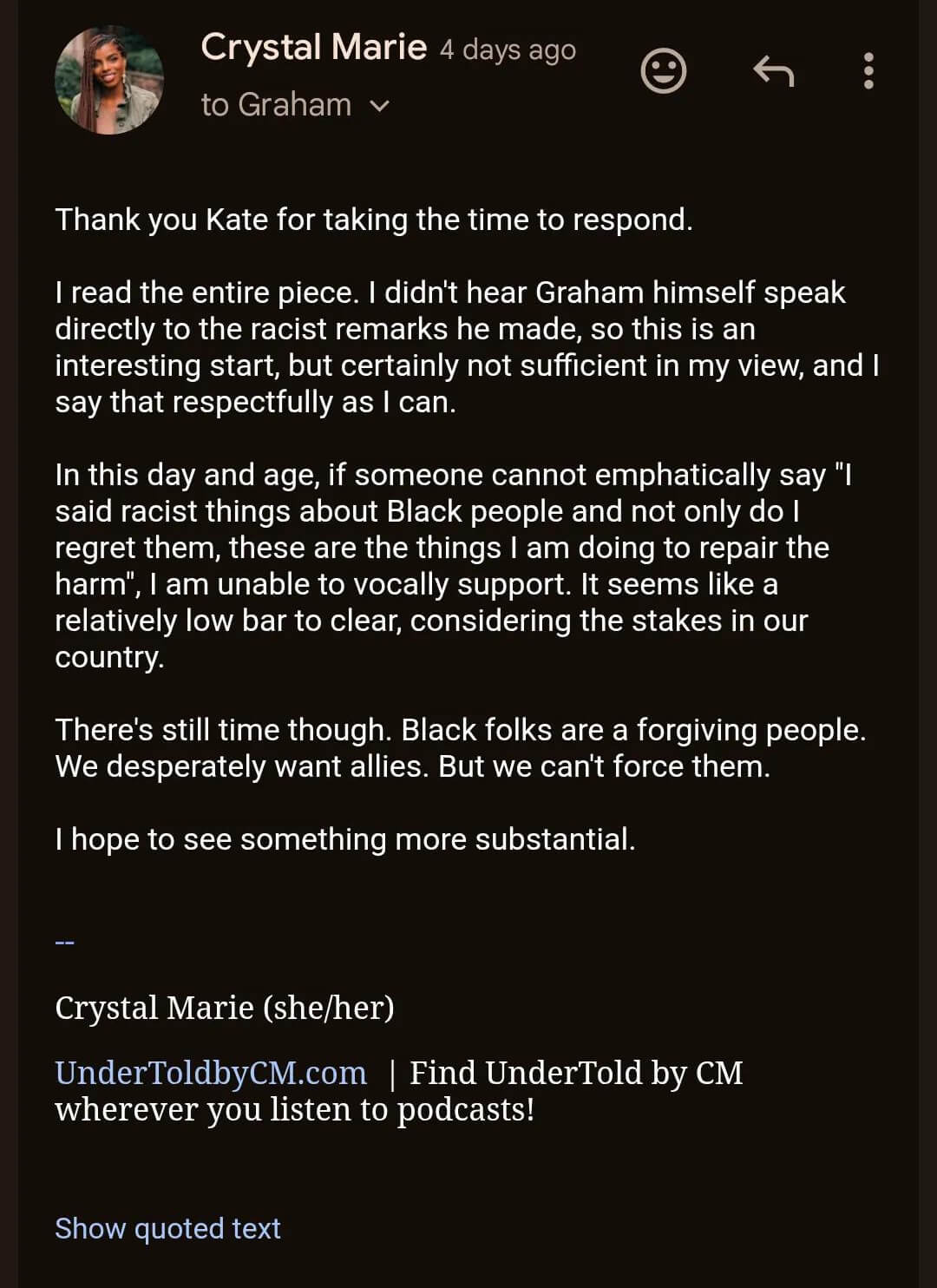
The Platner campaign responded by mentioning my work as “one of Maine’s most well-known and influential anti-racist educators” and linking to my previous writings about Platner.
I ended up responding directly to the poster, but it was at that moment I realized that with the primary voting day coming up fast, I probably needed to wrap up my thoughts around him. Despite the presumption that Platner will be the Democratic nominee for this midterm Senate race to face off against the thoroughly awful incumbent Susan Collins, the piece needed to be written, because there are still other candidates in the primary and lots of people have been expecting this follow-up and also some people seem ready to vote for anyone but Platner in the midterm election based on assumptions and apparently no concern for long-term consequences.
The thing is that almost everyone I know outside of Maine is puzzled by the rise of Graham Platner and why so many Mainers appear to be supporting him. Much ink and podcast time has been spent on covering Graham Platner and other folks in Maine but in almost every national piece I have read covering his candidacy, there are voices that aren’t being heard or even considered, and those are the voices of BIPOC Mainers.
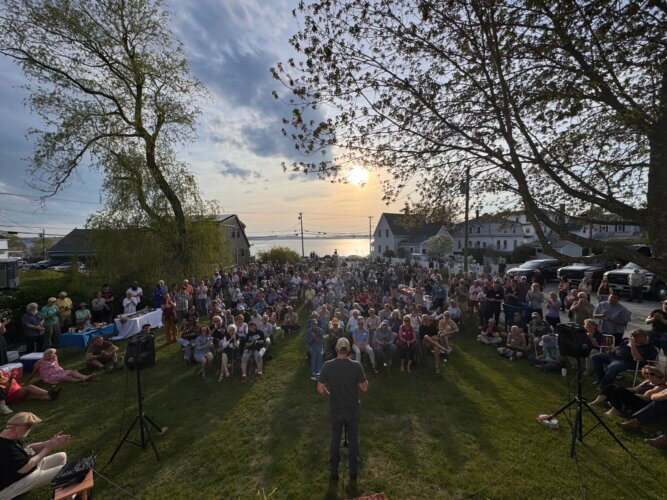
Last week, I attended a community event for Platner that was hosted on the island that I live on and was struck by the fact that a number of young Black Mainers were in attendance. These young people took the time and money to take a ferry ride to attend an event where they could hear Platner speak. It wasn’t an event being covered by the media; just a community event—the type that Platner has been known across Maine for hosting since he announced his candidacy. By all accounts, they were enthusiastic about Platner and here’s the thing: As a Black Maine resident, it doesn’t appear to me that it’s an anomaly.
There is a certain group of progressive white Maine voters who have decided that his past Reddit posts and tattoo that had some possible Nazi connotations have disqualified him (by the way, that tattoo was covered up with a new one. According to my meeting notes, it was already covered up the day we met for our first one-on-one interview in October 2025). Some go so far as to test the idea of supporting Susan Collins as an alternative to Platner, assuming he wins the primary. Of course, the rhetoric from a number of online non-Maine voters is similar but even more intense and vocal, with folks on sites like Bluesky constantly bemoaning “Why are people supporting a Nazi in Maine?” I might ask first why people are assuming he’s a Nazi when he shows no signs of such beliefs aside from a tattoo that most people wouldn’t have recognized as being Nazi (including him at the age he got it when it just looked like a cool tattoo) if a handful of people online weren’t telling them some Nazis wear it (guess what, Nazis have also appropriated some Norse runes, leaving non-Nazi Norse pagans and others to be assumed to be Nazis)—but I digress.
These conversations about him being a racist sort of guy ignore the fact that almost since the beginning of his campaign, Maine’s BIPOC community has seen him as a viable candidate and the support for him has only grown. No doubt because Maine’s overall BIPOC community (at 7-8% of the Maine population at best), is largely ignored but Platner didn’t disregard them.
In recent years, the population of Black and other non-white people has increased to the point where we have seen more BIPOC Mainers entering local and state politics. BIPOC Mainers (immigrant and non-immigrant alike) are building communities, revitalizing long-dormant cities and towns, and adding to the state in a myriad of ways, including filling much-needed jobs in a state with one of the oldest populations around.
In recent years, our state legislature has seen almost outsized numbers of BIPOC folks, particularly BIPOC women, serving in the Maine statehouse. So much so that in recent months, lawmaker and Somali-American Deqa Dahla has found herself being targeted nationally by folks aligned with the Trump administration. Weeks before he was killed, podcaster Charlie Kirk was in Maine and spoke on how immigration was ruining Maine and though he didn’t directly name Deqa Dhlac, he referred to her obliquely during his last Maine appearance when he said that people in Maine shouldn’t have the values of Mogadishu. More recently, the Trump administration and right-wing publications have been targeting Maine’s Somali-American communities with a steady stream of fraud allegations. In cities such as Lewiston, Maine, which is home to a large number of Somali immigrants, Somali residents have been targeted and harassed.
So little is ever discussed about Black Mainers that few outside of Maine are aware that our most recent previous Speaker of the Maine House was now-State Senator Rachel Talbot Ross, an eighth-generation Black Mainer. During her tenure as Speaker of the Maine House, Talbot Ross was part of a very small club of Black Speakers across the United States. For a state as white as Maine, the fact that we had a Black speaker of the House flew under the radar and continues to fly under the radar, much like how the voices of Black and Brown Mainers are still under the radar. It is almost insulting how little people know of Black and Brown Mainers despite the fact that we (I served in public office 2021-22, as vice chair of the Portland, Maine Charter Commission) have been steadily building power and growing our connections for over a decade now as our numbers have grown, and Black people have been here and been doing important things long before that as well. Both inside and outside the state, our existence tends to be ignored.
The continued and seemingly accepted erasure of BIPOC Mainers too often means that most candidates, even in Maine, do very little if any targeted outreach to Maine BIPOC communities. Despite the changing demographics over the last decade-plus, Maine is treated as a white state and local politicians outside of the more urban areas tend to not bother with reaching out to people and communities of color—and sometimes the urban politicians aren’t any better, honestly.
Which is why after my early meetings with Platner, I wanted to hear from actual BIPOC Maine voters on their thoughts about him. A number of people responded to my request and, overall, even in the aftermath of revelations about the tattoo and his past comments on Reddit, I was surprised that BIPOC Mainers remained enthusiastic about him—and this was before current governor Janet Mills suspended her campaign for the Senate race.
A couple examples of the responses I got follow here:
I’m in community with way more problematic people than Graham. Some of them would make better senators than Mills or Collins.
Discarding someone because they crossed a line is, in contrast, a core feature of puritanism. If God damns you for doing or saying something wrong, then maybe we should too. The idea of eternal damnation because you said or did the wrong thing underpins our absurd criminal legal system. This idea is in the New England air. Progressive culture has suffered deeply by embracing it. It is the antithesis of the abolitionist vision put forward by Angela Davis, Ruth Wilson Gilmore, and others. One might say, “well, of course we believe in redemption. Just don’t run for senate. Let him run for state house or city council.” That is like saying “of course I believe in second chances – just don’t let people with criminal records live in my neighborhood. Let them live over there, across the tracks.” This guy has generated a messianic following. We’ve caught lightning in a bottle. We can’t waste it. He erred. He grew. What more do we want? A beautiful future is full of reformed bigots, and Platner provides a model. I don’t want to belong to a party that says “stay out if you were ever bigoted. – CKM
***
I think I have a somewhat unique position on Graham because it was a week before everything dropped that I sat in on a listening session in Portland with him, his team, and other Black and POC community leaders to ask questions. I was middle of the pack in terms of leadership in that room I’d say, so it was good to be in that space and knowing that he most likely wasn’t concerned with my approval.
I thought at times he said things that were tough to digest like unintentionally saying red lining ‘used’ to exist and the room having to remind him it very much is still real. I wish he would’ve used that time to be honest about his Reddit posts for sure, but I did leave feeling cautiously optimistic. You could tell he didn’t have a clue about some policy stuff but that he recognized Black and brown people are incredibly overlooked in this state and I liked that he was specific with naming harm that establishment Dems have done to our communities – we are a small but mighty group and he understood that. It’s what’s made me still on the fence instead of brushing him off with the rest.
After sitting with everything I have come to two conclusions for myself: White people love to tell Black people how they should respond and react to racism without checking themselves. It’s giving the final boss of white savior complex with some of these folks. The second, is that I can’t ignore how none of this would be a conversation if it were a woman. Women have to be nearly perfect to run for even local office and a great political resume to make a run for US Senate. I still can’t confidently say if it were a woman, with his background, and some good sound bites at a rally, it would’ve gotten the same traction. I also don’t think women are ever given this much grace. That says something to me. And I think that’s a conversation in itself – how misogyny has been threaded into this conversation at every turn and yet, seems to be overlooked.
At the same time, I feel that if I canceled every white person in Maine who said something racist, misogynist, or just straight up ignorant, I would never know peace. I also think that Governor Mills has done much more harm to our community in Maine than a Reddit post full of ignorance. Even the tattoo. – RR
These were two of the most detailed responses, but my inbox was inundated with BIPOC Mainers sharing their thoughts on Platner with only one message from my non-white respondents saying they had decided outright not to support him. No one was excusing the harm his words created and, for Black and Brown people living in Maine, the majority of us are experienced at dealing with racialized microaggressions on a regular basis. Too often, that racism actually occurs at the hands of so-called allies, which I would say in my almost quarter of a century in Maine and working in Boston is a very New England staple. There is a belief that the region lacks the historically racist baggage of the South and that in places like Maine the absence of BIPOC people is therefore an absence of racism. Which erases the history that in fact, Maine was just as complicit in the trans-Atlantic slave trade as the South. The boat-building industry in Maine built the vessels that carried the human cargo—a tidbit that has only received public recognition in recent years—or how Klan activity wasn’t just targeted at Franco-Canadians who settled in places such as Lewiston-Auburn or the Biddeford Saco area. Local writer and citizen historian Samuel James goes into great lengths in his work to unearth that Maine’s whiteness wasn’t a fluke but an intentional design.
In the context of Graham Platner and his past actions and current campaign, these details matter. They matter even more because Platner is the only candidate to have made connecting with BIPOC communities a core value of his campaign. While national talking heads and Bluesky pundits love to lament the lack of diversity at his rallies, those photos are often used as proof of the racism within his campaign and possibly the state. What is missed is that true to his community organizing chops, he has been building relations with BIPOC communities and leaders since almost day one, which is the real reason so many BIPOC people in the state are choosing to support him.
Since day one, as I mentioned in my first piece, he has reached out to meet with BIPOC community members. By day four of his campaign launch back in August 2025, Platner asked for my phone number from a mutual friend, April Fournier.
April is a Navajo woman who is currently serving her term as a Portland, Maine, city councilor, and currently running for Maine House District 114. She also works on the national level to promote Asian American, Native Hawaiian and Pacific Islander participation representation across all levels of the political process. Suffice to say that April, as a BIPOC woman in Maine who engages in politics both locally and nationally, has had to fine-tune her sense of discernment about candidates—and she is a Platner supporter. We have had conversations about her support in light of the Reddit posts and even the more recent R-slur that Platner used (in reference to himself it should be noted) and she was frank with me that she has talked to him about these things and she sees the growth. For her it is his willingness to acknowledge his mistakes and seek ways to grow that has earned her support, aside from his desire to change the system and to directly name things like the oligarchy as enemies of progress.
Platner has also made huge inroads into Maine’s Muslim and immigrant community; one of his most visible Maine immigrant BIPOC supporters has been Somali-American Safiya Khalid. At just 30 years old, Khalid, whose family fled the Civil War in Somalia when she was seven years old, has amassed an impressive resume. After college, she worked for the Maine Democratic Party as a field organizer, she clerked for the Maine Legislature on the Committee for Housing and Labor, and she also has served on the Lewiston City Council. She also founded the Community Organizing Alliance where she currently serves as executive director. The mission of COA is to center the voices of BIPOC Mainers to be civically engaged and involved in their communities. I would say that Safiya was one of the first highly visible members of the BIPOC community to publicly support Platner’s campaign. While Platner has had Kahlid speak at his events, my observation is that the connection is deeper than political theater.
The moment I realized that Platner actually was really showing up in BIPOC spaces beyond just political meetings was during the January 2026 ICE raids that happened in Maine where our immigrant and BIPOC communities were terrorized by our federal government. Not even two days into the raids across the state, I got a text from Platner asking if I was okay and was there anything he could do for the community to keep people safe?
The thing was, he was out of the country at the time. He and his wife Amy were in Norway seeking IVF treatments, having recently gone public with their fertility struggle. I remember reading the text and thinking “damn, dude just reached out to check on me and see how he could be of service despite having a pretty full emotional plate.” I told him I was staying safe and he told me to let him know if there was anything I needed. Well, he was doing the same thing with others in the community. In fact, he arrived back in the States and immediately—like almost straight off the plane immediately—was attending local rallies in the community. In fact, on the day of one of the largest protests across the state during the ICE raids, Platner was walking with the community and showing up. Meanwhile, our governor and then-Senate candidate Janet Mills was spotted dining at one of Portland’s most upscale restaurants on a day when over 180 restaurants and businesses in Maine, the majority in Portland, decided to shut down in solidarity.
From that point on in January after the enhanced ICE enforcement efforts, I started to pay more attention to where candidates showed up and not just what they put out on social media. Though even in putting out statements, in a community as small as ours, you pay attention to who is bothered to speak to BIPOC issues or concerns. I am not the only one; our numbers are small and while it would be easy to ignore us, given the rising political power of Black and Brown Maine, you do so at your own expense.
In fact, in my recent interviews with the remaining Senate candidates, David Costello and write-in candidate Andrea LaFlamme, there seemed to be a distinct lack of connection with Maine’s BIPOC community. During my talk with Costello as he lamented the lack of attention his campaign was receiving, I asked if he has connected with the immigrant communities, given the attacks on Maine’s immigrant communities and how “New Mainers” as they are referred to are a huge part of Maine’s growth and economic vitality. He said he hadn’t been in contact because no one had contacted him.
In early April, Platner and I met for breakfast in Portland—less an interview and more a time for us to actually just talk. It was almost immediately apparent that since our October 2025 meeting, he had done some growing. He has accepted that the questions on the tattoo and the Reddit posts aren’t going anywhere and he has leaned into it—understanding that he fucked up but also being clear on where he was then and where he is now.
We talked more about his organizing experience as a mutual connection point since I had started my career over 30 years ago in Chicago as an organizer. In many ways, the Platner I met over coffee and eggs is the same man I met with in October 2025 and yet there are also signs of clear additional growth. I know mutual organizing connections from my day job who have been in touch with him—white men who hold a full racial and class analysis who early on wanted to connect with him.
His understanding has deepened and yet he also is the same gruff dude that people either like or don’t. I get it. Graham (and at this point I am using his first name because while I don’t consider us friends we are friendly enough that neither of us thinks anything about texting the other if warranted) is the embodiment of whiteness and an example of what it means for white people, at least in anti-racism spaces, to do some growing.
In my day job, my organization is the regional counterpart to national groups such as SURJ (Showing Up for Racial Justice) and I work with white people on dismantling racism, understanding that only when a critical mass of white people start to understand that the roots of racism are white supremacy and the culture of whiteness that they will realize their participation is required to dismantle a system that actively harms BIPOC folks. You can see the terrible inverse of racial ignorance playing out daily within the Trump administration, but at the same time, even they lose something fundamentally human under the system of whiteness despite their power, privilege and white skin. It isn’t enough for white people to simply not be overtly racist; it is how they show up and whether they are intentionally anti-racist that really matters.
While many people nationally and even within Maine are concerned that Graham is another John Fetterman, that comparison isn’t valid. In 2013, while serving as mayor of Braddock, Pa., Fetterman chased a Black jogger with a shotgun after hearing what he thought were gun shots. Fetterman held the unarmed jogger at gunpoint until the police arrived. From a racial perspective, Black Pennsylvanians always had their doubts about Fetterman and his later stroke and subsequent traumatic brain injury only helped others to start to wonder about his allegiance given that since that stroke his actions have labeled him a DINO—Democrat in name only.
Graham Platner made some racist and misogynistic comments after serving several tours of duty, and he got a questionable tattoo early in his military career. By all accounts, he left the military an extremely angry and fucked-up human because that is what serving in the military does to some people. As a friend—a Black woman in the midcoast of Maine who served six years in the Navy—has told over the last year: If you leave the military and don’t do an intentional factory reset on yourself, you will struggle. Apparently the things you do to survive in the military aren’t what you do to live outside the military.
I can’t speak to who Graham Platner was when he was posting hurtful things on the internet, but I can say that in the nine months since he launched his campaign, I have seen a white man who has done a lot more community-building across racial lines than the majority of those who judge him—particularly the left-leaning progressives and leftists who are horrified that he has a legitimate shot at becoming the U.S. senator. Most certainly more than the average politician or aspiring politician. The fact that he chooses to build behind closed doors rather than turning BIPOC people into props to redeem himself is also a choice. For those who seek the performative, there is no doubt that a few shots of him speaking with Black and Brown audiences and seeing their reactions would probably steady their nerves—but do photo ops allow for depth and true connection?
A month after the revelations of earlier racist and misogynistic posts, I was in a closed-door meeting with Graham and one of his handlers in a room of several prominent Black Maine voters. We were all eyeing each other with the “let’s see what this white man is going to say?” looks. In other words, is he going to be real since we all saw the comments or is he going to give us some white bullshit and a sob story? Two hours later, while no one was saying they were ready to offer any public support, the fact that he sat at a table of Black folks after those comments were revealed and held his own spoke a lot to me about his character. In some ways, I think one-on-one meetings where he is less nervous about flubbing up, you get the substance of who the man is. I was reminded of that again during our breakfast in April; he is incredibly well-read and not the kind of reading you get from reading the internet alone.
At the end of the day, Graham Platner is a white man in a country where privilege has been baked into his existence from day one—where it takes intentionality to grow beyond leaning into the dual privilege that he holds as a man and as a white person. I have lived long enough to know that even in anti-racism spaces, white people still engage in racist behavior though often not intentionally. Graham presents us with a quandary: In a world where we expect our politicians to be a certain way, to be polished and say the right things, we are lulled into the illusion and the artifice without actually seeing the true heart and character of the person.
Graham isn’t polished. He is messy sometimes and…well…that can be scary but at the same time he is real and given the reality of the current political climate, I value the messy and authentic over the artifice.
We are a fundamentally dishonest country when it comes to race and racism. Too many of the people who are opposed to Graham based on his history also failed to understand how little progress we actually made between the Civil Rights Era and the ascendance of Trump and, well, we are living with their failure. Trump isn’t an anomaly or the core problem; he is the symptom of our true health as a nation.
In nine months of talking to people who know Graham personally, meeting with him several times, and reading others’ accounts of him I have only come across one person who told me off the record they didn’t want to support him. When pressed, it turned out that it had nothing to do with his comments; it was just a general vibe that Graham isn’t polished enough. Aside from those who left his campaign early on, I have yet to hear from anyone in Maine with a story exposing some hidden truth about the man despite social media chatter that he is “probably” hiding something. Maine is a small state; the degrees of separation aren’t far. At this point, I fully expect that if someone has a time Graham dropped an N-bomb or harassed women, it would be out there. Again, having met with all the remaining candidates, I have been privy to various chatter about these people but despite being the most controversial candidate, there is surprisingly no chatter about Graham. It seems that at this moment what we see is what we get.
People have asked who I will be supporting. Despite how my other pieces have been read and interpreted by some, I wasn’t always sure and it was one of the reasons I wanted to use my access to meet all the candidates. While we have ranked choice voting in Maine, and I will make use of that benefit, there is only one person who is a guaranteed ranking for me and it is Graham.
I don’t need a perfect candidate and watching him show up consistently for Maine’s BIPOC community and not use the community to repair his battered image matters to me. In some ways, knowing for months that at any moment he could have chosen to “prove” that he has changed by taking relational moments and turning them into soundbites and photo ops—but he didn’t—reveals a level of integrity that is important to me.
PS: As an independent writer, as much as l love your comments and sharing, your financial support is what keeps my writing viable. Become a Substack subscriber today, or if you are interested in my more deeper and personal writing with an anti racism lens, become a Patreon patron. Or if you just want to show your gratitude for this piece, consider Buying Me a Coffee.
Main image credit: Photo by Amy Platner